

AI supports pre-qualification: it structures profiles, compares criteria and delivers traceable shortlists – fair, fast and GDPR-compliant.
Whether 20 or 2,000 applications: AI structures profiles, compares objectively against your criteria and delivers traceable shortlists – no black-box decisions, no unconscious bias.
Skills, career stages, qualifications, languages, certificates and soft skills are automatically extracted from CVs – whether PDF, Word or LinkedIn profile.
Consistent criteria and transparent scoring make decisions traceable. No unconscious bias from name, photo or age.
What used to take days, AI does in minutes. More time for personal conversations with the candidates who genuinely fit.
Data protection and access concepts are built in: consent, retention periods, logging, access rights – all documented.
Every recommendation is justified: why this candidate? Which criteria are met, which are not? Full transparency for HR and the line department.
Top talent is off the market quickly. With AI screening you respond in hours instead of weeks – and lose fewer A-candidates.
Skills, career stages, qualifications, languages, certificates and soft skills are automatically extracted from CVs – whether PDF, Word or LinkedIn profile.
Consistent criteria and transparent scoring make decisions traceable. No unconscious bias from name, photo or age.
What used to take days, AI does in minutes. More time for personal conversations with the candidates who genuinely fit.
Data protection and access concepts are built in: consent, retention periods, logging, access rights – all documented.
Every recommendation is justified: why this candidate? Which criteria are met, which are not? Full transparency for HR and the line department.
Top talent is off the market quickly. With AI screening you respond in hours instead of weeks – and lose fewer A-candidates.
The reality in HR departments: a job posting generates a large number of applications. A recruiter needs several minutes per CV for a first assessment. With a hundred applications that is many hours – just for the first review.
The result: recruiters skim CVs, make gut decisions, overlook good candidates. The best applicants already have other offers within days. And in the end it turns out the hired candidate was not the right fit after all.
With AI screening: all hundred applications are structured in minutes, assessed against your criteria and turned into a traceable shortlist. Your recruiting team focuses on the top ten – with all the information at a glance.
Nine core capabilities for more efficient, fairer and faster recruiting.
CVs are automatically analysed and structured: work experience with duration and responsibility, qualifications and degrees, hard and soft skills, languages with level, certificates and training. Whether PDF, Word, LinkedIn profile or even a photo scan.
AI also understands synonyms and related skills: "project management" = "project leadership" = "Projektleitung". Industry-specific taxonomies for IT, finance, engineering, healthcare and more.
CVs in English, German, French, Italian and more are understood equally and converted into a consistent format.
AI matches candidate profiles against your role profile: must-haves (exclusion criteria), should-haves (important but negotiable), nice-to-haves (bonus). Weighted by your priorities.
Each candidate gets a traceable score: an overall rating, partial ratings per criteria group, strengths and gaps at a glance. No black box – you see exactly how the score is reached.
Which requirements does the candidate fully meet? Where are the gaps? How large are they? AI shows development potential and onboarding effort.
Every assessment is justified and documented: why this score? Which criteria are met, which are not? What information is missing? An audit trail for compliance.
AI only assesses job-relevant criteria – not name, gender, age, photo or origin. Regular bias audits ensure no unintended distortions creep in.
AI spots anomalies and flags them for manual review: gaps in the CV, frequent job changes, missing qualifications, inconsistencies. You decide how to handle them.
Acknowledgements as soon as an application arrives, status updates as the process progresses, personalised rejections with respectful feedback. All based on your templates and tone.
Candidates choose appointments themselves from available slots. Automatic calendar entries, reminders and video-call links. No more email ping-pong.
Hiring managers receive structured candidate profiles with all the relevant information. Assessments and comments are collected centrally. Transparent decision-making.
| Aspect | Manual process | With AI screening |
|---|---|---|
| Time for first review (100 applications) | Many hours | 15-30 minutes |
| Time-to-shortlist | 3-5 days | Same day |
| Consistency of assessment | Varies by the day | 100% consistent |
| Documentation of decisions | Often patchy | Fully automatic |
| Unconscious bias | Demonstrably present | Systematically reduced |
| Candidate communication | Often delayed or forgotten | Instant and automatic |
| Scalability | Linear with staffing | Almost unlimited |
From a single role to mass recruiting – scalable solutions for every situation.
From analysis to live operation – typically within a few weeks.
We analyse your current recruiting process: which roles? What volume? Which criteria? Where are the biggest bottlenecks? Which ATS systems are in use?
Together with HR and the line departments we define role profiles: must-haves, should-haves, nice-to-haves, exclusion criteria. Weighting and scoring logic are set.
Connection to your ATS (Personio, Recruitee, Greenhouse, etc.). CV parsing is configured. Communication templates are created. The data protection concept is implemented.
Test with a selected group of roles. Fine-tuning of criteria and scoring logic based on feedback from HR and the line department. Validation of results.
Gradual expansion to further roles. The HR team is trained. Reporting and KPIs are set up. Continuous optimisation begins.
The possibilities are many: CV parsing, criteria matching, automated communication. But which solution fits your recruiting? We offer no theoretical lectures – instead, a hands-on assessment of where you stand.
3 hours • remote or on-site • incl. preparation and recommendations
Clarity on how AI can speed up your recruiting.
Detailed answers to the most important questions.
The process runs in several steps: 1) CV parsing: the AI reads CVs (PDF, Word, LinkedIn) and extracts structured data: work experience, qualifications, skills, languages, certificates. 2) Profile creation: from the extracted data a consistent candidate profile is created – comparable across all applicants. 3) Criteria matching: the profile is matched against your role profile: must-haves, should-haves, nice-to-haves. 4) Scoring: each candidate gets a transparent score with a justification. 5) Ranking: candidates are sorted by score – your shortlist is ready.
AI can be more objective than humans – when configured correctly. The advantages: AI only assesses job-relevant criteria, not name, gender, age, photo or origin. AI is consistent – no day-to-day fluctuations. AI documents every decision traceably. Importantly, we run regular bias audits to detect and correct unintended distortions. The final decision always stays with the human – AI recommends, you decide.
No, definitely not – and that is not the goal. AI takes over the time-consuming, repetitive groundwork: reading and structuring CVs, extracting information, matching criteria, building shortlists. Your recruiting team gains time for what humans do better: holding personal conversations, assessing culture fit, getting candidates excited about your company, making complex decisions, building relationships. The result: recruiters shift from administrators to strategic talent advisers.
Data protection is the top priority – especially with sensitive applicant data. Our measures: GDPR compliance from the start: consent, retention periods, access rights. Encryption in transit (TLS 1.3) and at rest (AES-256). Hosting in EU data centres or on-premise at your site. Role-based access control – not everyone sees everything. Audit logs for all access and processing. Automatic deletion after defined periods. We also support you in producing the required data protection documentation.
The common applicant tracking systems are supported: Personio, Recruitee, Greenhouse, Workday, SAP SuccessFactors, Softgarden, d.vinci, Lever, BambooHR, Bullhorn, and many more. Integration is via APIs or standard connectors: applications are imported automatically, candidate profiles and scores fed back, status updates synced. For systems without direct API support, integration via Zapier, Make or n8n is often possible.
Implementation time depends on scope: a basic setup is ready in a short time. A standard setup takes several weeks. An enterprise setup takes correspondingly longer. We recommend starting with a pilot area (e.g. one department or role category), showing value quickly and then expanding step by step.
The cost depends on complexity (number of role profiles, integrations) and application volume. The running costs typically pay for themselves quickly through time savings. Add the qualitative benefits: better candidate selection, faster time-to-hire, a more professional candidate experience. In a free initial consultation we put together a no-obligation quote for you.
Soft skills are harder to assess than hard skills, but AI can provide clues: from the CV – leadership experience, team sizes, project responsibility, volunteering. From the cover letter – communication style, motivation, self-presentation. From references – where available and analysable. Importantly, the final assessment of soft skills should always happen in a personal conversation. AI can give pointers and prepare questions for the interview – but empathy, teamwork and culture fit can only truly be judged in direct contact.
The system is flexibly configurable: you define how many candidates make the shortlist (e.g. the top 10 or top 20%). Candidates just below the threshold are flagged as a "watchlist". For each candidate you see exactly which criteria are met and which are missing. You can add candidates to the shortlist manually at any time. The system learns from your decisions and adjusts the weighting. The goal is not to exclude good candidates, but to help you find the best ones faster.


"Recruiters should get to know people, not sort CVs. AI can take over exactly that groundwork – faster, more objectively and around the clock."
The KIKOM team around Markus Kirchmair supports companies in automating their recruiting processes – from requirements analysis and ATS integration through to continuous optimisation. The focus: faster, fairer pre-selection without a black box.
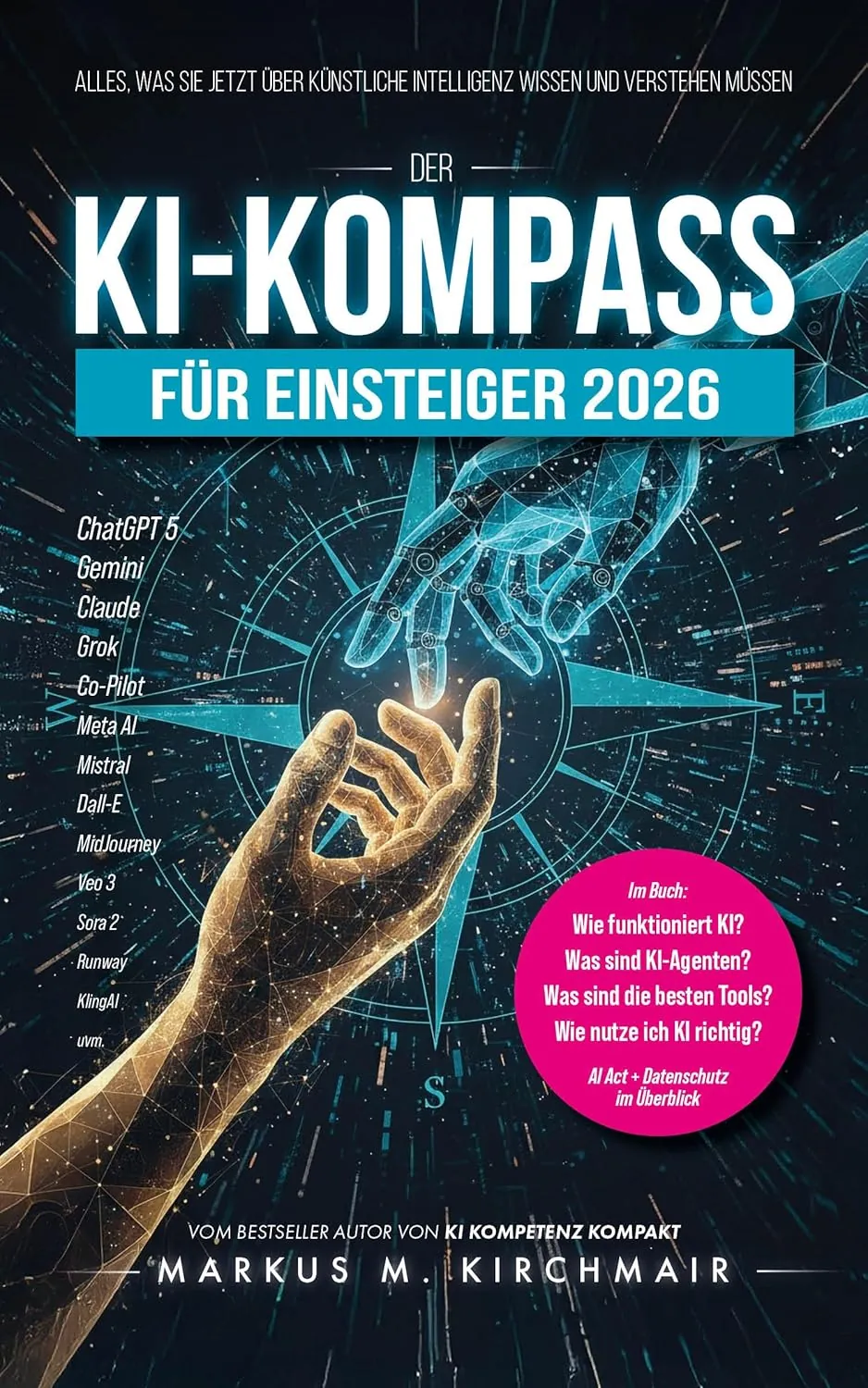
AI fundamentals, tools and regulation explained clearly.
Order now on AmazonLet's discuss how AI can speed up and improve your candidate screening.