

AI analyses your business data, recognises patterns and delivers clear recommendations – in natural language, not in spreadsheet deserts. Just ask, and AI answers.
AI data analysis is not just pretty dashboards. It means: recognising patterns, uncovering anomalies, building forecasts and delivering concrete recommendations – understandable for everyone in the company.
Data-driven insights instead of gut feeling. AI shows not only "what happened?" but "why?" and "what should you do now?" – with concrete recommendations.
What used to take days, AI delivers in minutes. Answer ad-hoc questions without waiting for the analyst. Speed up decisions.
AI finds connections in millions of data points that people overlook: customer behaviour, seasonality, correlations, drivers.
Predictions for revenue, demand, churn risk, stock levels. Plan ahead instead of reacting – with high accuracy.
AI recognises unusual developments automatically and alerts you instantly – before small problems become big crises.
"What was revenue last week in the southern region?" – AI answers directly, with no SQL skills. Make data accessible to everyone.
Data-driven insights instead of gut feeling. AI shows not only "what happened?" but "why?" and "what should you do now?" – with concrete recommendations.
What used to take days, AI delivers in minutes. Answer ad-hoc questions without waiting for the analyst. Speed up decisions.
AI finds connections in millions of data points that people overlook: customer behaviour, seasonality, correlations, drivers.
Predictions for revenue, demand, churn risk, stock levels. Plan ahead instead of reacting – with high accuracy.
AI recognises unusual developments automatically and alerts you instantly – before small problems become big crises.
"What was revenue last week in the southern region?" – AI answers directly, with no SQL skills. Make data accessible to everyone.
The reality of data: companies collect more data than ever – but only a fraction is actually analysed. The rest sits in silos: ERP, CRM, Excel files, web analytics. When someone has a question, it takes days for the analyst to find time. And by then the answer is often out of date.
The result: decisions are made by gut feeling. Opportunities are missed. Problems are spotted too late. And management wonders why the expensive BI tools are used so little.
With AI data analysis: anyone can ask questions – in natural language. AI searches all data sources, finds patterns and delivers answers with context and recommendations. In minutes instead of days. The result: data-driven decisions become the standard, not the exception.
Twelve core capabilities for data-driven decisions in real time.
AI searches your data for patterns, trends and anomalies – and presents the most important findings in an understandable way. Automatic visualisations, summaries and drill-downs.
Ask questions in natural language: "which products have the highest margin?", "why did revenue in the southern region fall?" – AI answers with figures, context and visualisations.
AI connects data from different sources: ERP, CRM, web analytics, Excel. Recognise connections that stay invisible in silos.
Predictions for revenue, demand, customer behaviour, stock levels. AI learns from historical data and forecasts future developments with high accuracy.
Which customers are at risk of leaving? AI recognises warning signs early: declining activity, support tickets, payment delays. Act proactively.
Demand forecasts for products, services, resources. Account for seasonality, trends and external factors. Optimise stock levels.
AI recognises unusual values automatically: sudden revenue drops, unusual order patterns, outliers in processes, fraud attempts. Instant alerts.
Define thresholds and conditions. AI monitors continuously and notifies you by email, Slack or SMS when action is needed.
Live dashboards with the key KPIs. Updated automatically, accessible on mobile, personalised by role and area of responsibility.
Not just "what happened?" but "what should you do?" – concrete, data-driven recommendations with expected impact and priority.
AI identifies customer groups automatically: high-value customers, churn risk, cross-selling potential, price sensitivity. More targeted outreach.
Play through scenarios: what happens if we raise the price by 10%? If we expand into region X? AI simulates the effects.
| Aspect | Traditional BI | With AI data analysis |
|---|---|---|
| Time for ad-hoc analysis | Days to weeks | Minutes |
| Who can ask questions? | Only analysts with SQL | Every member of staff |
| Recognising patterns | Manual, limited | Automatic across millions of data points |
| Forecasts | Often Excel-based, imprecise | High accuracy |
| Anomaly detection | Reactive (when noticed) | Proactive, in real time |
| Recommendations for action | Rare, interpretation-dependent | Concrete and prioritised |
| Connecting data sources | Laborious, IT-dependent | Automatic, self-service |
Data-driven decisions across every part of the business – with industry-specific models.
From data source to insight – structured and traceable.
We identify relevant data sources: ERP, CRM, web analytics, Excel, databases. What data do you have? Which questions do you want to answer? Which decisions should become data-driven?
Data is brought together, cleaned and structured. Data quality is the basis for good analysis. We identify and fix gaps, inconsistencies and duplicates.
AI models are trained on your data: forecasts, segmentations, anomaly detection. Validation with historical data. Fine-tuning for maximum accuracy.
Understandable visualisations and self-service access for your team. A natural language interface for questions. Setting up alerts and notifications.
Gradual introduction across the company. Training of users. Gathering feedback and optimising. Continuous improvement of the models.
The possibilities are many: sales forecasts, customer analysis, process optimisation, financial forecasts. But which analysis delivers the biggest value for you? We offer no theoretical lectures – instead, a hands-on assessment of where you stand.
3 hours • remote or on-site • incl. preparation and recommendations
Clarity on how AI can turn your data into decisions.
Detailed answers to the most important questions.
Classic BI shows what happened (descriptive). AI data analysis goes three steps further: diagnostic – why did something happen? AI finds causes and correlations automatically. Predictive – what will happen? Forecasts with high accuracy. Prescriptive – what should we do? Concrete recommendations for action. On top of that: a natural language interface (questions in plain language), automatic anomaly detection, cross-source analysis across data silos. You ask "why did revenue in the southern region fall?" – AI answers with causes, context and recommendations.
Practically all structured and semi-structured data: ERP systems – SAP, Microsoft Dynamics, Oracle, Sage. CRM – Salesforce, HubSpot, Pipedrive, Zoho. Web analytics – Google Analytics, Adobe Analytics, Matomo. Databases – SQL Server, PostgreSQL, MySQL, MongoDB. Cloud services – AWS, Azure, Google Cloud. Files – Excel, CSV, JSON. APIs – to external sources such as weather data, market data, social media. We bring data from different sources together and create a unified basis for analysis – without you having to change your existing systems.
No – and that is exactly the point. AI makes data analysis accessible to everyone: natural language interface – ask in plain language, e.g. "which products have the highest margin?" or "show me revenue by region for Q3". Automatic visualisations – AI picks the right format (chart, table, map). Plain-text explanations – not just figures, but context and interpretation. No SQL skills, no statistics expertise, no programming needed. Your sales lead, your marketing manager, your CFO – all can ask questions themselves and get answers.
Accuracy depends on several factors: data quality – the cleaner and more complete the data, the better the forecasts. Data volume – more historical data means better models. Typically we need a few years. Predictability – some things are inherently harder to predict than others. Generally, revenue forecasts and demand forecasting reach high accuracy, while harder-to-predict outcomes like churn are somewhat lower. We always validate models with historical data (backtesting) and show you confidence intervals. You know exactly how reliable a forecast is – and where uncertainty remains.
Implementation time depends on scope: a quick win (one data source, standard dashboard) takes a few weeks. A standard project (3-5 data sources, forecasts, alerts) takes several weeks. An enterprise project (many sources, custom models, company-wide rollout) takes a few months. We recommend an iterative approach: start with a pilot use case (e.g. sales forecasts), show value quickly and then expand step by step. That way you see results early and can prioritise based on experience.
Data protection and security are the top priority: encryption – TLS 1.3 in transit, AES-256 at rest. Hosting – EU data centres (GDPR-compliant) or on-premise at your site. Access control – role-based; not everyone sees everything. Audit logs – all access is logged. Data isolation – your data is strictly separated from other customers. Compliance – GDPR, ISO 27001, SOC 2 as required. We clarify the security requirements up front and document everything for your compliance department.
The cost depends on complexity (data sources, models, integrations). The investment pays for itself very quickly through better forecasts, fewer over-stocks, less churn and higher conversion. In a free initial consultation we put together a no-obligation quote for you.
Yes, self-service is a core principle: ask new questions – any user can immediately ask new questions in natural language. Adjust dashboards – a drag-and-drop interface for your own visualisations. Define alerts – set up your own thresholds and notifications. For more complex extensions (new data sources, custom models) we are available. We train your team and hand over the system so you can work independently.


"Most companies sit on a data treasure they never unlock. AI finally turns data into decisions."
The KIKOM team around Markus Kirchmair supports companies in implementing AI-assisted data analysis – from data integration and modelling through to understandable dashboards. The focus: analyses that trigger decisions, not just show figures.
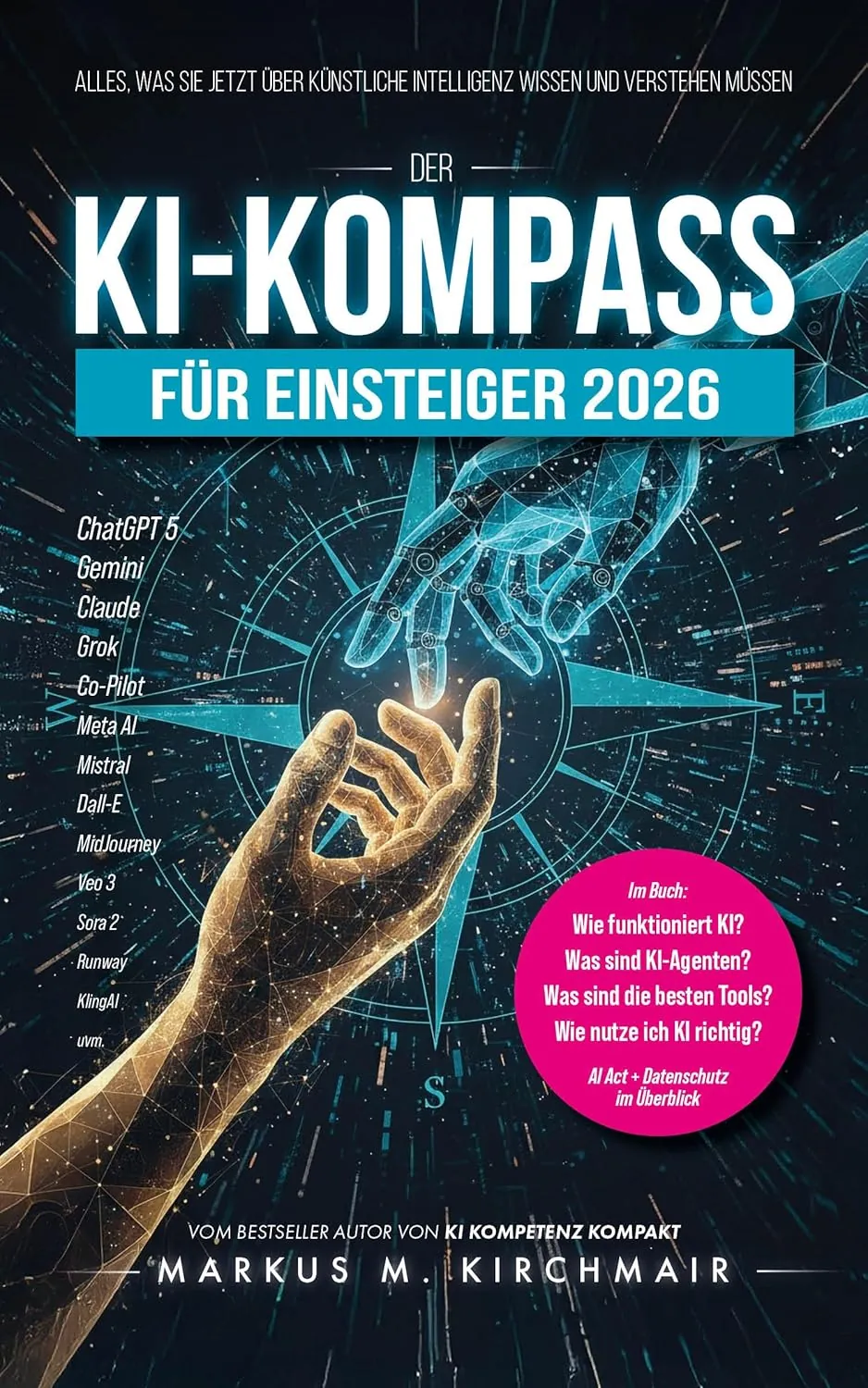
AI fundamentals, tools and regulation explained clearly.
Order now on AmazonLet's discuss how AI can turn your data into insights and recommendations.